Legal and Financial Consequences of Improper Document Disposal
The cost of a paper-based breach reaches far beyond the recovery effort. Regulators treat improper document disposal as a failure of basic security, and the penalties reflect that. Several federal rules apply directly to how businesses must handle records at end of life.
The FACTA disposal rule requires businesses that use consumer report information to take reasonable measures to protect against unauthorized access during disposal. The rule applies broadly, covering employers, landlords, lenders, insurers, and many service providers. Violations can result in federal enforcement actions, state-level penalties, and civil lawsuits from affected individuals.
In healthcare, HIPAA-compliant document management sets clear expectations for how protected health information is collected, stored, and destroyed. Improper disposal of patient records is one of the most common HIPAA violations, and settlement amounts often reach into the hundreds of thousands of dollars for a single incident. Financial firms face overlapping pressure from GLBA, and publicly traded companies face SOX considerations for records tied to financial reporting.
Beyond regulatory action, businesses face direct financial damage, including breach notification costs, credit monitoring for affected individuals, legal fees, insurance premium increases, and lost client trust. A structured disposal routine is far less expensive than a single breach response, and it gives leadership a clean answer when auditors ask how end-of-life records are handled.
How Professional Shredding Services Prevent These Risks
Professional shredding removes the weakest links in the chain. Office staff stop carrying loose papers to the wrong bin. Documents stop sitting in open recycle bins overnight. Records stop traveling in unsecured trash bags. Each step in the process becomes documented, controlled, and repeatable.
A professional document shredding in Indiana routine typically includes:
- Locked collection consoles placed throughout the office, with the vendor holding the only key
- Scheduled pickups by uniformed staff in GPS-monitored, locked vehicles
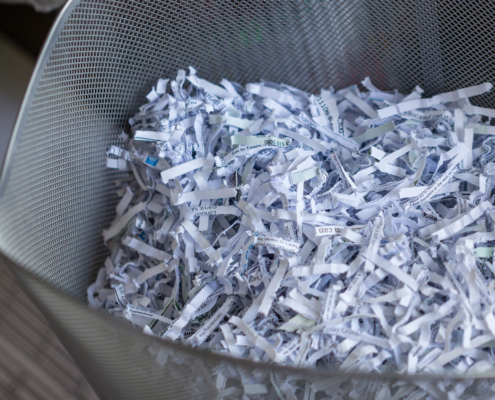
- Cross-cut destruction at a secure facility, not in the back of a truck or office
- Recycling of shredded material in baled, mixed loads that cannot be reassembled
- A certificate of data destruction available for compliance files and internal audits
That last item matters more than many businesses realize. When regulators or insurers ask how records are destroyed, a certificate of data destruction gives leadership concrete proof rather than a verbal assurance. It also supports vendor reviews, internal audits, and client questions tied to data handling.
Professional service also removes the bottleneck that office shredders create. Small machines jam, overheat, and depend on every employee to follow through perfectly every time. A scheduled service replaces that fragile routine with a system that runs the same way each visit. For businesses subject to the FACTA disposal rule or HIPAA, that consistency is the difference between a defensible process and a regulatory finding.
Lock Down Your Disposal Process With IRM
Improper document disposal creates risk that builds quietly until it becomes a public problem. Indiana Records Managers helps businesses across Central Indiana close that gap with secure pickup, locked transport, cross-cut destruction, and clear documentation, all built around how your office actually runs. Pricing stays straightforward, every call is answered locally, and switching from your current vendor is simple.
Get started with a disposal routine that protects your data, your clients, and your compliance standing from the first pickup forward.